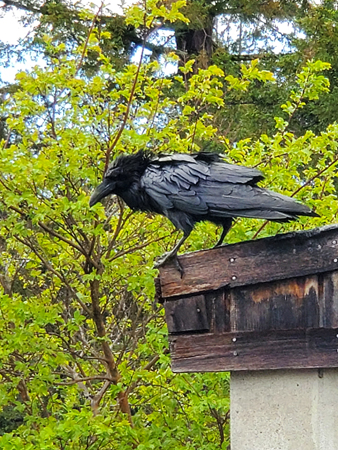
What better way to restart the blog than with a raven picture? Happy May, 2024, everyone.
What better way to restart the blog than with a raven picture? Happy May, 2024, everyone.
That’s it. That’s the post.
I’m thrilled!
That title isn’t a metaphor for anything. We’re expecting hard rain and high winds this afternoon/evening. Already, the branches are lashing and the lights have flickered twice. I’m trying to prepare for a power outage. I won’t say ” the inevitable,” but… it’s what I’m thinking.
My phone will be fully charged and this morning, first thing, I charged up one of “power brick”– a long-term battery that will power a phone or a tablet in a crunch.
This laptop is fully charged and so is the Surface Go. I also charged up the Verizon portable router that (theoretically) gives me internet access, but honestly, during the last two outages, I couldn’t get to the internet with it, although I could with my phone.
I also plan to check the pantry. I know we have several cans of soup, so we won’t starve (we can light the stovetop burners with a match)–but I might grind up some coffee. I have my priorities after all.
We have two battery-operated lanterns and dozens of battery tea-lights, which provide a soft, romantic glow to light us while we sit in the dark. more importantly, we each have an attachable book-light.
I think we’ll be okay.
I have badly neglected my blog. Next year I’ll… oh, I’m not even going to bother finishing that sentence.
Catching up on a a few small, fun things: Two library blogs chose Comeuppance Served Cold for their Best of 2022 Lists. The Los Angeles Public Library Blog included it.
King’s County Public Library in Washington state did too, and I’ve very happy about this one, because Seattle is the county seat. I think it means I got Seattle right, anyway! I was thrilled to be third on this list, thinking they were ranked in some way–and then I saw that they were alphabetical by author’s last name. I’m grateful my name starts with a front-of-the-alphabet letter.
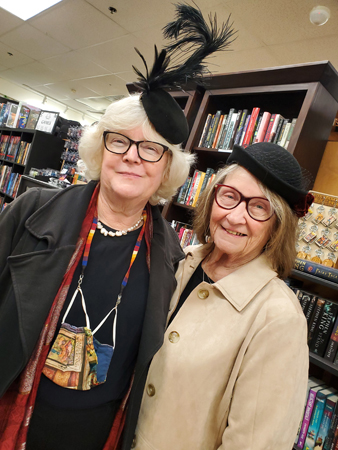
Solstice Night, December 21, I went to Word Horde Emporium of the Weird and Fantastic to read a ghostly tale. Sharon joined me and we wore our Hattery hats. (I trimmed the one I’m wearing.) The turnout was great, and three of us read; David Templeton, Petaluma’s own fiction writer, playwright, columnist and editor, read, as did horror publisher and shop owner Ross Lockhart. I read last, a story with ghosts, witches and reality TV. I heard the applause, but more importantly, people chuckled in the right places, so I felt great about it.
Christmas brought us fewer books and more bookshop gift cards this year, so we have something to look forward to during the short, cold days of January!
Somewhere back around 2019 (I think) the name “Karen” became a generic pejorative for a privileged white woman who was nearly always harassing a person of color, or treating a retail worker badly. Now it’s nearly 2023, and the Karens are reclaiming their name and redefining their purpose; working for justice. You, too, can hire a Karen to go to bat for you in a myriad of tiny ways.
I hope the final days of 2022 are peaceful, healthy and happy for all of you, and that 2023 sees you reaching for your dreams–and embracing them.
I have book recommendations for some of the folks on your gift-giving list this year. Here we go:
Books for the Reader of Feel-Good Books:
Remarkably Bright Creatures by Shelby van Pelt. The book got lots of buzz for its bright gossipy giant Pacific octopus (and he is the first character we meet), but the human characters are great too—quirky, real, all too human. The happy endings are relative and earned—for everyone (even the octopus).
The Last Mechanical Monster.Brian Fies’s latest graphic novel will show up here in a couple of places. This is a funny and touching story about heroes, villains, and the nature of connection. I thought hard about putting it here, because there is quite a bit of sadness near the end… but it’s a story that ends with optimism, caring and hope instead of cynicism and isolation.
And the artwork is amazing.
For the Good of the Realm. Nancy Jane Moore’s light-hearted swordplay fantasy adventure gender-swaps the characters from Dumas’s The Three Musketeers, in a world almost like ours but … not quite. Plenty of sword fights, intrigue, romance and wit!
Books for Urban Fantasy Readers:
N.K. Jemisin’s newest release is The World We Make, but it’s the second book in a duology. I think you have to read The City We Became first. Both books are great. Jemisin’s command of language, especially as she whirls through the different point of view characters, is brilliant and flawless. And the concept of self-aware cities is just awesome. If you are wealthy (or extravagant) give your reader both! Otherwise, order The City We Became.
K.D. Edwards has completed the third book in his series THE TAROT SEQUENCE, about Atlanteans living on Nantucket island after an Atlantean war destroyed their original home. Book Three is The Hourglass Throne, which came out this year, but again, you really should start with The Last Sun. These books feature excellent world-building and a comprehensive magical system that seems to draw from gaming traditions, plenty of action and lots of banter. Great books for the urban fantasy fan, especially one who might be looking for books with men loving men.
Books for Mystery Readers:
The Unkindness of Ravens, by M.E. Hilliard, introduces a new first-person sleuth in upstate New York, with an interesting setup and outstanding setting. Greer Hogan has an interesting backstory and like many detective characters, a personal mystery to solve. This book sets up the town and the quirky local characters, but the mystery gets full attention.
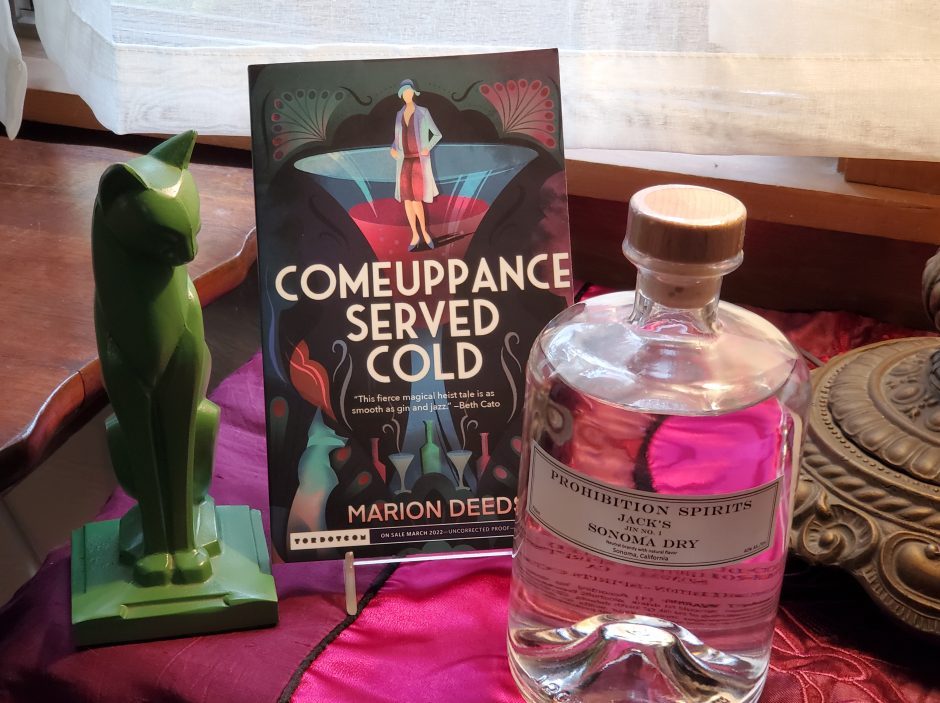
Comeuppance Served Cold, by me. Yes, as a published writer I am obligated to list my own book. It’s not exactly a mystery—it’s closer to a heist, but lovers of con artists, the Jazz Era and magic will like it.
Books for Science Fiction Readers:
Again, I’m recommending a duology, but both books are available in paperback. Arkady Martine’s A Memory Called Empire and A Desolation Called Peace are both wonderful. A Desolation Called Peace is probably more clearly SF since it’s a first contact story, while A Memory Called Empire reads like a political thriller, but here again, you have to have read the first one.
Living Memory, by David Walton. Walton writes some of the best Big Question, What-If science fiction around these days, and his latest, standalone Living Memory has one of my favorite characters ever—spoiler alert, he’s a dinosaur. Walton creates a non-human culture that is plausible, and gives them a serious problem to solve—while also following two human scientists whose discovery has massive implications for humanity. Almost everyone will find something to like here.
The Annual Migration of Clouds is a short novella by Premee Mohamad, about a sustainable community in a world devastated by the effects of global warming. Our main character has a chance to go away to school–but that leaves a hole in her tightly-knit community, plus, she must contend with the fungus that has colonized her and will ultimately control her nerve system. Short, fast-paced and powerful, in spite of that set-up, this is a hopeful story.
Readers of Gothic Horror:
Mexican Gothic by Silvia Moreno-Garcia is a perfectly period, perfectly creepy gothic horror story, now available in paperback. Anything by Moreno-Garcia is good; this one will tickle all the senses of your gothic horror fan.
Little Eve by Catriona Ward. This is the first book I’ve read by this author, but I recommend it for the horror readers on your list. We talk a lot about atmosphere with gothics—this book provides a master-class on it, whether it’s the disturbing ruin of a castle inhabited by the odd “family” of which the Eve character is a member, or the more pastoral village nearby. The book is filled with allusions, mirages, clues, and a nasty depiction of how a charismatic leader can manipulate the people in their power.
Readers of Graphic Novels:
Again, The Last Mechanical Monster.
Readers of Nonfiction:
Going back to one from a few years back; Entangled Life by Merlin Sheldrake. Fungus and lichen, and how they connect the world. Brilliant.
My suggestions. Let me know yours! List them in comments.
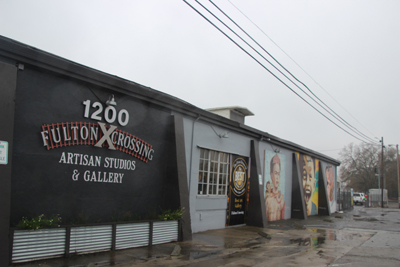
Fulton Crossing is an artist collective and gallery who held their Holiday Art Walk this weekend. The building used to be a chicken processing plant. When I worked at Copperhill, I’d often come to work up Fulton Road. Those days when the plant was still open, I’d often look to my left as I drove past, to see rows of chicken carcasses, hanging from hooks, jerking their way across what is now the courtyard. And some mornings there would be a terrible acrid smell, like ammonia.
Food’s important, but it’s much more pleasant as an art place.
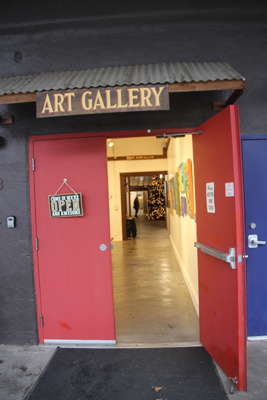
I got an email from a potter I follow, notifying me of the Art Walk. She doesn’t have her studio here but she rents retail space–the first one as you go through the door. There are fabric artists, potters, and fine artists in the mix, along with one gift shop that carries the work of other artisans. I took few/no pictures of the actual fine art at the artists’ requests, but there is still plenty to see. Like most true fine art, all of it was out of my reach, but most of the artists have reasonably priced prints and even cards you can buy. And they have a raffle this weekend so you might win something cool.
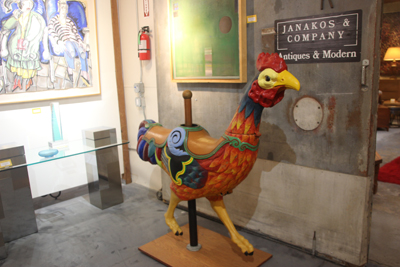
A pair of painters who are married to each other have the second floor space. Their styles are completely different from one another. The husband was on-site and I talked to him for a bit. He has a view of the SMART Train track (hence, Fulton Crossing) right out the window, and they both got to watch the track behind rebuilt.
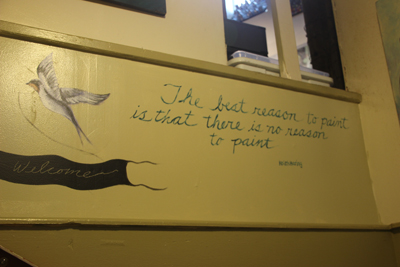
I recommend the gallery. It’s visible from River Road if you head east. If you come up Fulton, you can make a left turn onto River Road and an immediate left again into the lot… or you can park anywhere and walk the one block to it. Fulton is not a “town,” it’s a Census-designated Area, which might be a way of saying it’s small.
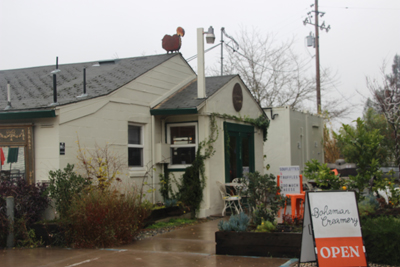
Fun fact: Bohemian Creamery is about two miles from my house, I drive past it about once a week, and I’d never stopped there until yesterday. Most weekends they offer tours, even during the holiday season. You get three free cheese tastes (but the young man behind the counter threw in a fourth for me because he wanted me to taste the same cheese only aged longer). Their Cowpoke Blue is sublime if you like bleu cheese. I also bought some Three Trick Pony cheese, which reminds me of Joe Matos’s cheese. It’s pricey, but I would certainly buy it again for a special occasion, or as a gift for a cheese-lover. They also offer Cheeses Flights for Two for $38, something to consider.
This was my second “holiday shopping” outing, and I consider it successful. Yes, it was cold. Yes, it rained. I put both of those down to Adding Atmosphere. And it made me appreciate the nice warm house more when I got home.

The season of nominating works for the 2023 awards, like the Hugos and the Nebulas, will open soon, so this period is the “eligibility list” season, in which writers let readers know what works of theirs are eligible to be nominated and ultimately voted for.
COMEUPPANCE SERVED COLD is eligible for nomination, and so is GOLDEN RIFTS.
That’s my list!
A couple of months ago I had a conversation in the checkout line with Cameron, one of my favorite checkers at the grocery store. He always asks about my writing. I said that I was working on something and trying to keep each chapter to five or six pages each. It was a change for me, since I usually wrote longer chapters.
Cameron nodded encouragingly. “Just keep at it. You’ll get it! You will!”
Thanks, Cameron.
That got me thinking about chapters. Why chapters? What purpose do they serve? Does the length matter? Should it matter?
I went to the internet to see why it thinks books have chapters. First off, here’s Dictionary.com’s definition: “A main division of a book, treatise or the like, usually bearing a number or a title”.
(You can tell I didn’t take a very deep dive there.)
Next, I looked at some of the online fiction-writing expert sites. Somewhat to my surprise, the number one reason several of them gave for having chapters in fiction was: To give your reader a break. “Break” was used in two senses. The first was a convenient place to stop reading, a landmark to where to start when you pick up the book again. That seems like the most logical purpose for me.
The second use of “break” is like a rest break, even if the reader continues to read. A chapter ending/beginning is a cue, and moment of time for the reader to reflect and absorb information before the story continues. I like that too.
Can you tell a story without chapters? Off the top of my head, I can think of two examples that worked; The Road by Cormac McCarthy, and Dolores Claiborne by Stephen King. In The Road, the endlessness of the prose combined with recurring incidents and themes expertly sold the dystopian future of this world, and echoed back the title. With King’s book, Dolores’s rage grew like a well-fed fire and the straight-ahead storytelling choice accentuated that.
And me, I write chapters. I just do. I think in chapters. I think in scenes, actually, but my mind combines them into convenient bundles. I use chapters:
A change of mood can also mean a dramatic moment that changes what the characters and the reader thought they knew. If The Empire Strikes Back had been a book, the line, “I am your father, Luke,” would have been a perfect chapter ending.
On those expert sites, advice ranges from “on your first draft don’t even bother with chapters, just write it,” to detailed outlining advice. Some sites prescribe chapter length (Middle Grade, for instance) or use a formula; total word count proportioned in some specific way. They also want to teach you how to craft a chapter. A chapter (in fiction) is made of scenes; each scene must have a beginning, middle and an end. Each chapter must have a beginning, a middle and an end, and every book must… yeah, you get the idea. It’s a lovely wheels-within-wheel image that doesn’t always work, but it’s probably a helpful model.
And then this guy just flat-out tells you what your chapter word-count should be.
One site suggested starting a chapter in the middle of a scene; others suggest outlining each chapter by “purpose.” Yet another suggests using a chapter to introduce the MC and primary characters—not shifting points of view, but devoting the chapter to each character. There were many other formulae and they probably all work to differing degrees of success for different authors. My approach to chapter breaks is usually more intuitive, and I’ll be the first to admit that my sense of story rhythm is affected as much by film and TV as it is books.
One thing I learned recently, by trying consciously to write a book with shorter chapters of nearly equal page length; short chapters weren’t right for the story, for a couple of reasons. It’s a complicated story. When I reread parts of it, instead of feeling like I had a “rest break,” I felt fragmented. The short chapters made me think that the tension, and the pace, were ramping up, when they weren’t—or at least not at the pace these chapter lengths were telegraphing. This book will do better with longer chapters that grow shorter as the suspense heightens (I hope) . I also ended up with 90+chapters. Who needs that? If I’m going to write a five-page-per-chapter book, it needs to be a shorter one.
With the thing I’m working on now, I’m using longer chapters again. Maybe not much longer; this book is designed to be shorter in length. Still, an average chapter so far runs to ten pages or slightly over.
Anyway—chapters. I like ‘em. That’s my report.
I haven’t blogged in over a month. Mostly, I’ve been busy keyboarding like crazy on a Comeuppance sequel, it’s heading into Holiday Season, and there have been a few personal issues taking up our time and attention. The poor blog has languished.
I struggled to find something to write about. The universe saw those struggles, took pity on me, and delivered a cornucopia of material in the form of a news story about an alt-right personality’s attempt to get a movie made of his comic-book, Confederacy-loving superhero character, and how he was allegedly scammed out of nearly $1 million dollars.
There is so much that makes this story a delight as a story. The surname of the alleged financial grifter is Wolfgramm. I couldn’t make that up. I couldn’t, but I very nearly did—one thing that does irritate me about this tale is that Wolfgramm (an assumed name) is very close to the villain in the Comeuppance sequel. It’s close, and it’s better. Damn it!
I’ll leave the link here and let you read it. (For some of us, it’s behind a paywall.) Here’s another link with more data.) But the fun, for us speculative fiction types, is just beginning.
Some of the fun is right on the surface. “Rebel,” is, I guess, a superhero who cribbed her costume from Wonder Woman but substituted used the confederate flag for the bodice. She goes around the world fighting a left-wing global police organization that imprisons free-thinking people. Her creator was envisioning a feature film to rival, well, The Avengers. I mean, I could stop right there.
Or I could start with the alleged scammer, James Wolfgramm, who has been charged with seven counts of fraud. He worked out of Utah, a state that wants to give the Dakotas a run for their money (that’s a pun) as the new USA “offshoring” hotspots. He named his financial business Ohana, (anyone who knows Hawaiian, savor that for a moment) and one of his comments was that he offered “banking services to the unbankable.” Ohana, that kindly family bank, is incorporated in the Kingdom of Tonga.
I could stop right there, too.
But those aren’t really the best parts. There is an element of just desserts in this story, at least for some of us—or, if you give the kaleidoscope of this tale one more twist, perhaps a very different story indeed. That’s because of who our alleged victim is. It’s Theodore Beale, aka Vox Day, architect of the attempted coup at the Hugo awards in 2015. That’s right. On the surface, it seems like the Rabidest of the Rabid Puppies (their name for themselves, honest) fell for a scam anyone who watched one season of Leverage might have clocked to.
Or did he? Because as anyone who watched Leverage also knows, one of the best ways to dodge suspicion in a scam is to be scammed yourself, one of the indignant victims. You might even toss out suggestions that the scam was motivated by people on the left who want to attack and destroy your alt-right “community,” by stealing the money you crowd-funded for your film.
It’s easy to believe that gadfly Beale was so arrogant and desperate to bring “Rebel’s Run” to cinematic life that he got taken in by this scam. The little bit of reading I’ve done of Beale’s fiction, his market copy for his personal micro-press, and his blog posts, shows a person whose confidence in his own vision, intelligence, creativity and power of will vastly exceeds his actual vision, intelligence, and so on. Some might say, a perfect mark.
Beale is also the complete opportunist. He seized on the sense of entitlement of some disgruntled writers in 2015 and hijacked their movement, putting together a concerted group who controlled the nominations for the Hugo awards that year. Amazingly, many of the works they got onto the finalist list were edited by Beale. What a startling coincidence! In 2016, he tried the same thing again with even less success, and many of the titles they foisted onto the voters were published by his press. In retrospect, it became clear that both these shenanigans meant free publicity for Beale and his press. Is it so much of a stretch to think that there are two scammers, not one, at the heart of this?
Beale’s father, once a celebrated, Christian millionaire from Minnesota, served a ten-year sentence for income tax evasion. You can read more here, but please understand that it wasn’t just “Ooops, I knew I forgot to do something! It was pay my taxes!” No, Robert Beale set up a detailed an elaborate plan to not report income and not pay taxes, and he pulled others in with him. He was also a federal fugitive for 14 months, during which time he hid out in Florida and went on a cruise. Parents don’t define us; but it’s possible Theodore Beale learned a few tips and techniques growing up at his father’s elbow.
Whatever happened here, it is intriguing, and filled with unintentional irony. I doubt we’ll hear more, but I really wish we would.
A capsule review of Shelby Van Pelt’s novel Remarkably Bright Creatures: this book is an absolute charmer.
Like others who have reviewed it or discussed it, I’m going to start with the octopus, because, after all, he starts the book. Marcellus is a giant Pacific octopus who lives in captivity in a small aquarium in the small Pacific Northwest town in which the book is set. Marcellus is very smart, very observant and speaks excellent English, so there’s no reason in the world why this book should not open with him addressing us in first person, and sharing his point of view about the various humans he knows.
Marcellus is a smart creature (although he resents being called a “smart cookie”), and he is aware of his own mortality–in fact, he is counting down the months and weeks of his lifespan. This doesn’t stop him from regularly escaping from his tank and wandering the aquarium, which is how he makes the personal acquaintance of Tova, who cleans the place after hours. Marcellus has watching Tova for a long time, but now the two become… well, friends.
Tova has her own issues, and her own circle of human friends. At the core of her life is a devastating mystery–how and why did her eighteen-year-old son disappear, thirty years ago? Tova, a reserved woman, holds her grief and many other fears close to herself, until events begin to unfold that she can’t control. Meanwhile, a smart but adrift young man, Cameron, journeys north from Stockton, enduring a series of small catastrophes that might set some kind of a new record for bad luck and bad decisions. Fortunately, Ethan, a friendly shopkeeper who is secretly in love with Tova, lends Cameron a helping hand… and things spiral from there in a book that is warm, profound, sometimes sad, often funny and deeply hopeful.
Pick it up for the octopus, stay for the loving and lovely descriptions of small-town lives and the way we make connections.